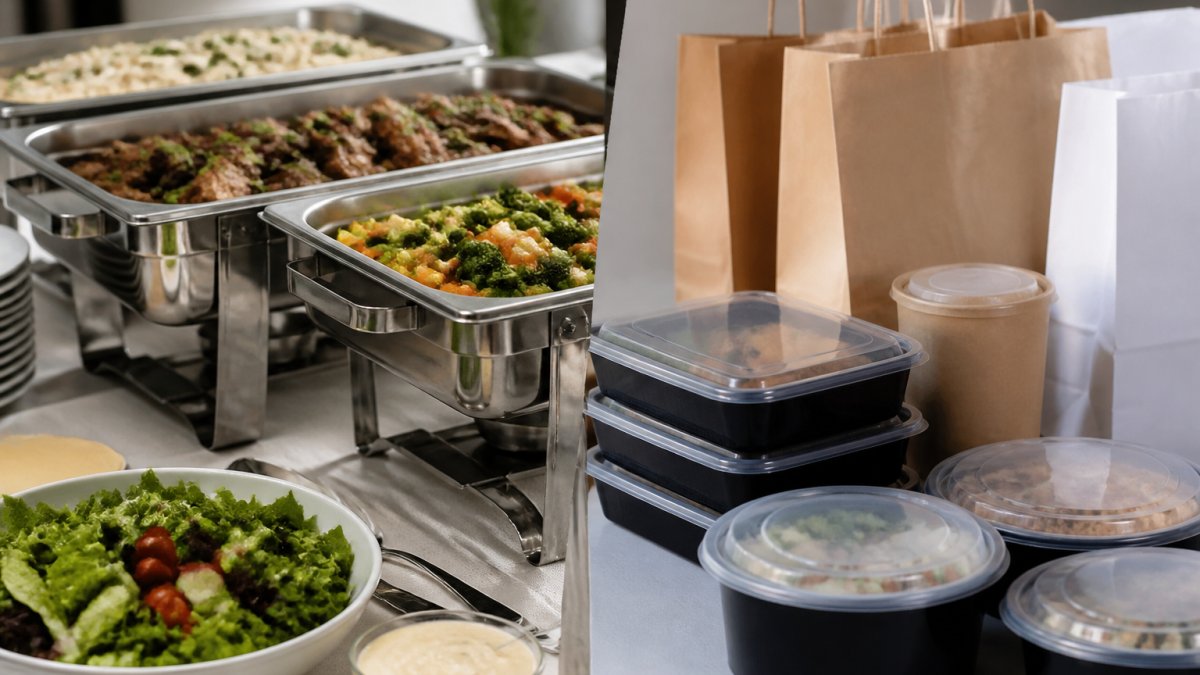
 comparison
Corporate Catering vs Restaurant Delivery: 2026 Guide
Table of Contents
- Corporate Catering vs Restaurant Delivery: Key Differences
- Drop-Off Catering vs Full-Service Catering: What You're Really Getting
- How to Calculate Catering Cost Per Head in 2026
- Corporate Lunch Catering Ideas and Execution
- Logistics, Delivery, and Setup: What Each Option Requires
- Food Safety, Liability, and Compliance Standards
- Decision Matrix: When to Choose Corporate Catering vs Restaurant Delivery
- Frequently Asked Questions
Last Updated: September 30, 2026
Corporate Catering vs Restaurant Delivery: Key Differences
The choice between corporate catering and restaurant delivery shapes how your event feels, costs, and runs. The difference isn't just about food, it's about experience, logistics, and what gets delivered to your guests.
Corporate catering means a full-service operation with professional staff handling setup, temperature control, plating, and cleanup. Restaurant delivery is simpler: food arrives in containers, you handle plating and service. Catering costs more upfront but removes operational headaches; delivery saves money but puts the burden on you.
Drop-Off Catering vs Full-Service Catering: What You're Really Getting
Drop-off catering means the caterer delivers food in heated containers and leaves; you handle plating, serving, and cleanup. Full-service catering includes staffed setup, on-site food management, service, and breakdown. Professional staff manage heating, cooling, food safety compliance, and guest interaction.
For 20 people in a conference room, drop-off works fine. For 100 people in a formal setting, full-service prevents cold food, overwhelmed hosts, and food safety violations.
FDA food safety guidelines for catered events outline temperature control and handling standards that full-service caterers manage automatically. Drop-off catering puts compliance responsibility on you. That's not theoretical, it's a liability issue.
Cost difference: drop-off runs roughly 30-40% less than full-service for the same menu. But that math changes when you factor in your time managing service, rental equipment for heating, and the risk of food safety issues.
How to Calculate Catering Cost Per Head in 2026
Calculating catering cost per head sounds simple but hides what actually drives price. Most planners compare only quoted food cost and miss hidden expenses that flip the economics.
The food cost layer. A whole hog or lamb roast is a significant part of your true cost.
The service and labor layer. This is where restaurant delivery and catering diverge sharply.
Restaurant delivery: You pay the per-head food cost, plus delivery, plus service fee. You absorb 2-4 hours of staff labor for setup, service, and cleanup.
Drop-off catering: You pay the per-head food cost, plus delivery, plus service markup. Your labor time is 1-2 hours.
Full-service catering: You pay the per-head food cost, plus service markup covering staffed setup, on-site management, service, and breakdown. No hidden labor cost or equipment rental.
The equipment and rental layer. Restaurant delivery requires heating equipment rental ($30-75 per item; $120-450 for a 50-person event). Full-service catering includes all equipment. Drop-off catering sometimes includes basic heating; confirm in the quote.
Real-world cost comparison for a 50-person corporate lunch:
Restaurant delivery scenario:
- Food cost: $15 per head × 50 = $750
- Delivery fee: $100
- Service fee (18%): $153
- Equipment rental (4 chafing dishes): $200
- Your staff labor (3 hours at $30/hour): $90
- Total: $1,293 | Per-head cost: $25.86
Drop-off catering scenario:
- Food cost: $18 per head × 50 = $900
- Delivery fee: $75
- Service markup (12%): $117
- Your staff labor (1.5 hours at $30/hour): $45
- Total: $1,137 | Per-head cost: $22.74
Full-service catering scenario:
- Food cost: $22 per head × 50 = $1,100
- Service markup (25%, includes all staff, setup, equipment, cleanup): $550
- Total: $1,650 | Per-head cost: $33.00
The per-head food cost alone ($15, $18, $22) doesn't tell the story. When you add labor, equipment, and delivery, restaurant delivery becomes the most expensive option. Full-service catering costs more per head but eliminates operational burden and liability risk.
How to use this framework:
- Get quotes from three sources: restaurant delivery, drop-off catering, and full-service catering. Ask for per-head food cost, delivery fees, and service markups.
- Add your estimated labor cost (hours × hourly rate).
- Add equipment rental if needed.
- Compare total cost, not per-head food cost.
- Factor in risk: restaurant delivery puts food safety liability on you; full-service catering transfers it to the caterer's insurance.
For events under 30 people (casual), restaurant delivery often wins on total cost.
Corporate Lunch Catering Ideas and Execution
Corporate lunch catering works best when it matches your event's tone and team preferences. Start with menu variety: vegetarian, vegan, gluten-free, and protein-focused options matter.

Logistics, Delivery, and Setup: What Each Option Requires
Restaurant delivery logistics require you to provide serving utensils, warming equipment, plates, napkins, and staff. Most offices lack proper heating equipment, so food cools quickly. Setup takes 20-30 minutes; cleanup is your responsibility. Corporate catering logistics include site assessment, equipment delivery, setup crew, temperature management, service, and breakdown. The caterer manages these; you confirm headcount and dietary restrictions.
Food Safety, Liability, and Compliance Standards
Food safety is legal, operational, and your personal liability. The standards differ sharply between restaurant delivery and professional catering. Most planners don't realize they are personally responsible for compliance when they choose delivery.
Who is liable if someone gets sick?
Temperature control: The compliance foundation.
Temperature control is the single biggest food safety compliance issue. FDA Food Safety Modernization Act and state health codes require:
- Hot food must stay at 140°F or above
- Cold food must stay at 40°F or below
- Food left in the temperature danger zone (40-140°F) for more than 2 hours is unsafe
Allergen disclosure and cross-contamination prevention.
Permits and licensing.
How to audit a caterer's food safety practices.
Before hiring a caterer, ask these questions:
- Are you licensed and insured? Request proof of a current food service license and general liability insurance. Verify the insurance covers catering events at off-site locations.
- What is your food safety certification? Caterers should have staff certified in food safety (ServSafe or equivalent). Ask how often staff are retrained.
- How do you manage temperature control? Ask about specific equipment: heated holding cabinets, ice baths, thermometers. Do they monitor temperature during the event?
- How do you handle allergens? Ask for their allergen protocol. Do they maintain separate utensils and serving areas? Can they provide ingredient lists for all menu items?
- What is your cleanup and sanitation process? Professional caterers should follow USDA food safety standards for catered events for cleanup, including proper waste disposal and equipment sanitation.
- Do you have a food safety plan? Larger caterers should have a Hazard Analysis and Critical Control Points (HACCP) plan or equivalent. This shows they've thought through food safety systematically.
The practical decision framework:
- Under 25 people, informal, 2 hours: Restaurant delivery is acceptable.
- 25-75 people, semi-formal, 2-4 hours: Drop-off catering is safer.
- 75+ people, formal, 3+ hours: Full-service catering is necessary.
- Guests with severe allergies: Full-service catering only.
- Events where reputation is at stake (client meetings, awards dinners): Full-service catering.
Decision Matrix: When to Choose Corporate Catering vs Restaurant Delivery
The decision isn't about preference, it's about event size, formality, and your operational capacity.
| Factor | Restaurant Delivery | Drop-Off Catering | Full-Service Catering |
|---|---|---|---|
| Headcount under 25 | Good fit | Acceptable | Overkill |
| Headcount 25-75 | Marginal | Good fit | Better fit |
| Headcount 75+ | Poor fit | Acceptable | Best fit |
| Casual office lunch | Best fit | Good fit | Overkill |
| Client presentation | Poor fit | Acceptable | Best fit |
| Formal event | Poor fit | Marginal | Best fit |
| Your available setup time | 30+ minutes | 45+ minutes | None required |
| Food safety responsibility | You manage | Shared | Caterer manages |
| Staff provided | None | None | Full team |
Choose restaurant delivery when:
- Headcount is under 20 people
- Event is informal (office lunch, casual meeting)
- You have 30+ minutes to handle setup and service
- Food safety liability is acceptable to you
- Budget is the primary constraint
Choose drop-off catering when:
- Headcount is 25-50 people
- Event is semi-formal (team lunch, internal gathering)
- You have 45+ minutes for setup
- You want professional food but can handle basic service
- You want moderate cost with professional quality
Choose full-service catering when:
- Headcount exceeds 50 people
- Event is formal (client meeting, awards dinner, important presentation)
- You want zero operational burden
- Food safety and liability management matter
- The event reflects your organization's standards
Frequently Asked Questions
Is catering cheaper than restaurant delivery for large groups?
Cost depends on group size, menu complexity, and service level. Restaurant delivery typically costs less per person for groups under 20, but full-service corporate catering becomes more economical at 50+ guests because setup, staffing, and equipment costs are distributed across more attendees. Calculate your per-head cost by dividing total event cost by headcount to compare fairly.
What is the difference between drop-off catering and full-service catering?
Drop-off catering delivers food and containers; you handle setup, serving, and cleanup. Full-service catering includes professional staff, on-site setup, temperature-controlled service, and cleanup. Full-service costs 30-50% more but eliminates your operational burden and ensures food safety compliance. Choose drop-off for informal office lunches; choose full-service for client meetings or formal events.
How do I calculate catering cost per head in 2026?
Divide your total catering budget by the number of guests. For example, a $1,500 event for 50 people equals $30 per head. Include all costs: food, service fees, delivery, staffing, and equipment rental if applicable. This metric helps compare restaurant delivery against professional catering fairly and ensures you stay within budget as headcount changes.
Does restaurant delivery include setup and service staff?
Standard restaurant delivery does not include staff or setup. Food arrives in containers; you arrange plates, utensils, and serving. Professional corporate catering includes trained staff who handle presentation, serving, temperature management, and cleanup. For events over 30 people, the absence of staff in restaurant delivery creates operational stress and food safety risks.
Planning a corporate event that needs more than standard delivery? Shaka Braai brings 20+ years of experience creating memorable dining experiences for corporate gatherings. Our whole hog and whole lamb roasts, prepared with fresh, locally sourced ingredients and served by professional staff, elevate your event beyond typical catering. Request a call back to discuss your event and get a quote tailored to your headcount and vision.