 How-to
Can You Increase Catering Profit Margins Without Raising Prices?
Last Updated: November 4, 2026
Quick Summary
You can increase catering profit margins without raising prices by trimming food cost through better ordering and portioning, cutting on-site labor hours, and tracking all four cost buckets on every quote. In the worked example, those changes lifted net profit from 20.1% to 26.8% on the same $4,500 invoice.
- Assign overhead by dividing trailing twelve months of fixed costs by billable event labor hours.
- Add 5-10% for trim and spoilage when building each dish's plate cost.
- The most common margin killer is unpaid setup and breakdown time.
- Calculate equipment ROI as annual margin gain divided by purchase price.
- Review quoted versus actual cost after every event to stop margins drifting.
Table of Contents
- Start With Real Numbers: How to Calculate Catering Costs
- How to Price Food for Catering Without Guessing
- Catering Price List Examples That Protect Your Margins
- Control Food Cost and Waste to Lift Catering Profit Margins
- Labor, Staffing, and the Costs Competitors Forget
- Strategies to Increase Catering Sales and Average Order Value
- Review Every Event to Find Your True Catering Profit Margins
- Request a Quote and Build Your Next Menu Around Margin
- Frequently Asked Questions
Start With Real Numbers: How to Calculate Catering Costs
Most caterers price from instinct, then wonder why the month ends with less money than expected. Strategies for increasing catering profit margins start with one hard truth: you cannot protect a margin you have never measured. This guide walks through the math, the pricing, and the small operational moves that lift profit without raising menu prices. For the cost-per-head math behind each quote, see our guide to calculating catering cost per head.
Catering profit margin is the percentage of revenue left after food, labor, and operating costs are paid. Gross profit covers food and labor only. Net profit also subtracts overhead, equipment, insurance, and marketing. Contribution margin sits between the two: revenue minus all variable event costs (food, hourly labor, delivery, disposables, payment fees), before fixed overhead. Contribution margin is the number to watch per event, because it tells you what each job actually throws off toward rent, insurance, and profit.
The Four Cost Buckets Every Event Quote Needs
Every quote should carry four numbers, not one:
- Food cost: ingredients, plus trim loss and spoilage
- Labor cost: prep hours, on-site hours, travel time
- Operating cost: fuel, rentals, disposables, delivery
- Overhead share: insurance, licensing, storage, admin
A common mistake is quoting food and labor only. Overhead does not vanish because you forgot it. A practical way to assign overhead is to divide your trailing twelve months of fixed costs by billable event labor hours, then load that rate onto each quote. If fixed overhead runs $6,000 a month and you bill 400 event labor hours a month, every labor hour carries about $15 of overhead. A 60-hour event then absorbs roughly $900 of overhead, visible, defensible, and impossible to forget.
A Worked Event-Level Profit Example
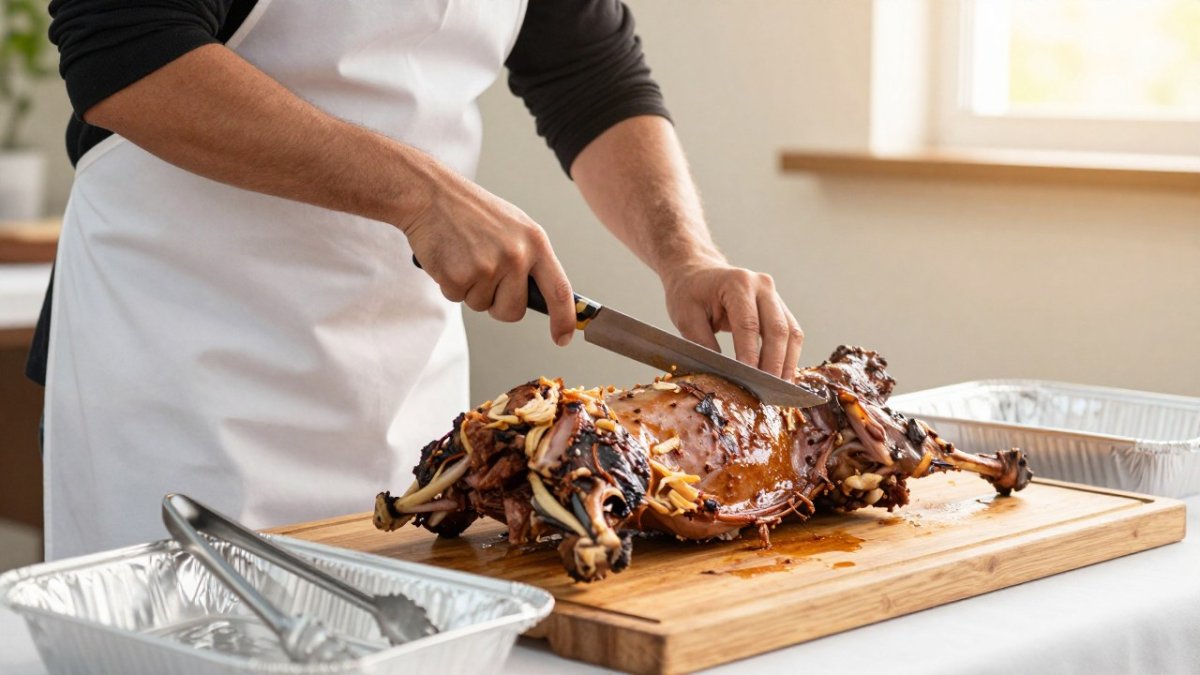
Consider a hypothetical 100-guest backyard event with a whole lamb roast and sides, using an illustrative $4,500 revenue figure. Build the costs line by line:
| Line item | Amount | % of revenue |
|---|---|---|
| Revenue (100 guests × $45) | $4,500 | 100% |
| Food cost (lamb, sides, disposables in food) | $1,260 | 28% |
| Event labor (2 prep + 4 on-site + 1 travel hour × 3 staff) | $990 | 22% |
| Delivery, fuel, and rentals | $315 | 7% |
| Payment processing (about 2.9% + $0.30 per transaction) | $131 | 2.9% |
| Overhead share (60 labor hours × $15) | $900 | 20% |
| Net profit | $904 | 20.1% |
That is the real picture: a 20% net margin, not the 33% the percentages suggest when overhead and payment fees are left out. Now run the same event with two changes. Trim food cost to 25% through better ordering and portioning, and cut one on-site labor hour by pre-plating desserts. Food drops to $1,125 and labor to $825, lifting net profit to $1,204, a 26.8% margin on the same $4,500 invoice. Same price, more profit, and now you can see exactly which lever moved it.
Benchmark Your Margins Against the Industry
Catering can run leaner on rent than a restaurant but heavier on labor and transport, so compare your event-level contribution margin to your own trailing average first, then to published benchmarks. If your food cost is at 35% while labor is at 18%, you have a purchasing or portioning problem, not a pricing problem.
Calculate ROI on Equipment and Menu Investments
Not every margin move is a cost cut. A new smoker, a heated holding cabinet, or a vacuum sealer is an investment, and it should earn its keep. Calculate ROI as the annual margin gain divided by the purchase price. If a $2,400 holding cabinet lets you prep proteins a day earlier and cuts event-day labor by two hours per event across 40 events, at a $30 loaded hourly rate that is $2,400 a year in labor savings, a one-year payback before you count the reduced waste from better holding. Run the same math on delivery vehicles, software, and rental vs. purchase decisions for chafing dishes and linens. Investments that pay back inside a season are easy yeses; anything past two years needs a harder look.
How to Price Food for Catering Without Guessing
Pricing food for catering starts with plate cost, not competitor menus. Build each dish from ingredient costs, add a waste allowance, then apply your target margin.
Follow this order:
- Cost every ingredient at the portion you actually serve
- Add 5-10% for trim and spoilage
- Multiply by your target food-cost percentage
- Compare the result to market rates, not the other way around
Many caterers find that high-protein dishes like whole hog and lamb carry a higher plate cost. Price those as premium items rather than absorbing them into a flat per-head rate. The USDA FoodData Central database is a useful reference for standard portion and nutrition data when building plate costs.
Catering Price List Examples That Protect Your Margins
A price list should show tiers, not one flat number. Tiered menus protect margin because guests self-select into packages with known cost structures.
| Package | Service Style | Best For | Margin Protection |
|---|---|---|---|
| Drop-off | Delivered, unserved | Office lunches, casual parties | Low labor, tight food cost |
| Buffet | Staff-served stations | Weddings, family events | Balanced labor and food |
| Plated | Full table service | Formal dinners | Premium pricing, higher labor |
| Roast station | Chef-carved on site | Signature events | High perceived value |
For a real menu to model your own list against, you can view our full catering menu. Notice how each package pairs a service style with a clear cost structure.
Control Food Cost and Waste to Lift Catering Profit Margins
Food cost is the fastest lever you control. Waste, over-ordering, and loose portioning eat margin quietly, event after event.
Start with these habits:
- Track wastage on a simple sheet after every event
- Weigh portions during prep, not by eye
- Order against confirmed guest counts, not headroom guesses
- Review inventory weekly so nothing spoils unseen
Vendor negotiation matters too. Ask for volume pricing on your highest-cost proteins, and compare supplier costs each quarter. Small savings on the biggest line items compound fast.
Labor, Staffing, and the Costs Competitors Forget
Labor is where quotes quietly fall apart. Staffing levels, travel time, and setup hours all belong in the price.
A practical staff-to-guest ratio keeps service smooth without over-staffing. Buffet and drop-off events need fewer hands than plated dinners. Build labor into the quote as a line item, never as an afterthought. Service style drives labor cost, so if you are weighing options, our breakdown of full-service vs drop-off catering shows how each model changes your staffing math.
Watch out: the most common margin killer is unpaid setup and breakdown time. If it is not in the quote, you are paying for it yourself.
Strategies to Increase Catering Sales and Average Order Value
Strategies to increase catering sales work best when they raise order value without raising prices. Upselling and cross-selling do exactly that.
Try these moves:
- Offer a signature appetizer add-on at booking
- Bundle sides and drinks into a package
- Suggest a dessert station for larger guest counts
- Quote a repeat-booking discount for corporate clients
Track which profitable customer segments order which packages. Historical data shows you where to focus sales growth. For more ideas on growing event revenue, browse our catering blog.
Review Every Event to Find Your True Catering Profit Margins
A post-event review turns guesswork into a repeatable system. Compare quoted cost to actual cost on every job.
Ask three questions after each event:
- Where did food cost run over or under?
- How many labor hours were actually used?
- Which items sold best, and which sat unsold?
Log the answers. Over a season, patterns appear: certain dishes waste more, certain events need more staff. Adjust your next quote using real numbers, and your catering profit margins stop drifting.
Request a Quote and Build Your Next Menu Around Margin
Margin discipline is a habit, not a one-time fix. Measure your four cost buckets, price from plate cost, control waste, and review every event. Do that, and you can grow profit without touching your menu prices.
At Shaka Braai, our family-owned team brings over 20 years of experience to weddings, corporate events, and backyard gatherings. We handle whole hog and whole lamb roasts, fresh locally sourced ingredients, and professional staff who serve your guests, so you can focus on the event itself. Ready to price your next event with confidence? Request a call back and let our team build a menu around your margin.
Frequently Asked Questions
What are the typical profit margins for catering?
Catering margins vary widely by service style and overhead. Net profit after labor, delivery, rentals, and overhead is typically much thinner than gross profit. The only reliable figure is your own: track food cost, labor, and event costs per job, then compare net profit against revenue. Events with heavy staffing and long travel days will always run lower than simple drop-off orders, so benchmark by service type rather than one company-wide number.
How do you calculate a catering business profit margin for a single event?
Add every cost tied to that event: food and beverage, labor including prep and travel time, delivery and setup, packaging, rentals, and a share of overhead. Subtract that total from the event revenue to get net profit, then divide net profit by revenue for your margin percentage. Run this on every job for a few months and you will see which event types and menus actually make money. That per-event habit is the fastest way to improve catering profit margins across the whole business.
How can caterers reduce food waste and control costs?
Start with historical data: compare guests served against food prepped for your last 20 events and adjust your ordering formulas. Use portion control on plated service, track wastage by item, and build menus that reuse trim and surplus across dishes. Review supplier costs quarterly and negotiate on volume for your highest-use proteins. Small changes compound quickly. A caterer who trims over-ordering by even a few percentage points per event frees up cash that goes straight to the bottom line.
What are some strategies to increase catering sales without discounting?
Raise average order value instead of cutting prices. Offer add-on courses, upgraded proteins, dessert packages, and beverage service that guests expect at events. Build minimum-order rules for delivery zones so small jobs stay profitable, and design packages around your highest-margin items. Upselling to existing corporate clients and asking for repeat bookings costs far less than acquiring new customers. Track which profitable customer segments book most often, then aim your marketing at them.