 How-to
Clean Label Snacks for Sustained Focus at Work
Last Updated: November 19, 2026
Quick Summary
Clean label snacks are foods with short, recognizable ingredient lists and no artificial preservatives, colors, or sweeteners. To sustain focus at work, pair protein, fiber, and healthy fats in a modest 150 to 250 calorie snack eaten around 2 p.m., before the afternoon slump begins.
- Aim for roughly 5 grams or less of added sugar per serving in a workday snack.
- Ingredients are listed by descending weight, so check whether sugar or refined flour appears in the first three.
- Unsalted nuts, seeds, and plain roasted chickpeas should list no oil at all.
- Eat your snack around 2 p.m., before the slump that usually hits between 2 and 4 p.m.
- Portion family-size bags into small containers on Sunday night to avoid overeating.
Table of Contents
- Why Clean Label Snacks Beat the Vending Machine for Workday Energy
- How to Read an Ingredient List and Spot Genuinely Clean Label Snacks
- The Balanced Snack Formula for Steadier Energy and Sustained Focus
- Healthy Portable Snacks No Refrigeration Needed for Your Desk Drawer
- Healthy Snacks for Work No Fridge Required: Nuts, Seeds, and Whole Grains
- Brain Food for Memory and Concentration: What the Evidence Actually Supports
- Building a Desk-Friendly Snack Plan for Different Workdays
- Stocking Your Office with Shaka Braai Biltong and Droewors
- Frequently Asked Questions
Why Clean Label Snacks Beat the Vending Machine for Workday Energy
Clean label snacks are foods made with short, recognizable ingredient lists and no artificial preservatives, colors, or sweeteners. The vending machine is the wrong tool for the 3 p.m. crash. Most of what it sells is built on refined flour, added sugar, and cheap oils, and that combination spikes your blood sugar and drops it again within the hour.
The alternative is not complicated. A desk drawer stocked with nutrient-dense options, planned on purpose, keeps energy levels steady through long meetings and deep work blocks. Below, we show you exactly how to build that drawer and which snacks earn a place in it.
How to Read an Ingredient List and Spot Genuinely Clean Label Snacks
Start with the ingredient list, not the front of the package. Front-label claims like "natural," "wholesome," or "made with real fruit" are largely marketing language, while the ingredient panel and the Nutrition Facts panel give you something you can actually compare across products.
1. Count the ingredients and check their order. Ingredients are listed by descending weight (the FDA). A five-ingredient rule of thumb works for most snacks, but order matters more than count. If sugar, a syrup, or a refined flour appears in the first three ingredients, the snack is closer to a dessert than a focus food.
2. Screen for added sugar, not just total sugar. The Nutrition Facts panel lists "Added Sugars" in grams per serving, and major health organizations recommend keeping daily added sugar intake low (Added Sugars).
3. Identify the oil. Oils are where many "healthy" snacks quietly fall apart. Unsalted nuts, seeds, and plain roasted chickpeas should list the nut or legume itself, maybe a little salt, and no oil at all.
4. Scan for additives you would not keep in your kitchen. Common additives in snack foods include artificial colors (Yellow 5, Red 40), artificial sweeteners (sucralose, aspartame), preservatives (BHA, BHT, TBHQ), and flavor enhancers (monosodium glutamate, disodium inosinate).
5. Read the serving size before you judge the numbers. A snack with 4 grams of added sugar per "serving" may define a serving as three crackers, while the bag holds eight servings. Multiply before you compare.
For concrete product examples that pass this test, see our guide to the 5 best clean label snacks for busy professionals.
Watch out: "Natural" and "clean" are not regulated claims, so a package can carry either word while still listing added sugar, refined oils, or artificial flavors in the ingredient panel.
The Balanced Snack Formula for Steadier Energy and Sustained Focus
A balanced snack pairs three things: protein, fiber, and healthy fats. Protein and fiber slow digestion, which softens the blood sugar curve, while unsaturated fats add staying power. A snack built on complex carbohydrates alone, like a plain cracker or a banana, burns through quickly.
Pair Protein, Fiber, and Healthy Fats
Think in combinations rather than single items:
- Greek yogurt with berries and pumpkin seeds
- Apple slices with nut butter
- Whole-grain crackers with hummus
- Biltong with a handful of walnuts
If you are weighing biltong as your protein source, our breakdown of whether biltong is healthy covers the nutrition and safety evidence before you commit.
Portion Size and Timing for the Afternoon Slump
The afternoon slump usually hits between 2 and 4 p.m. Eat your snack before it starts, ideally around 2 p.m., and keep portions modest, roughly 150 to 250 calories. A snack is a bridge to your next meal, not a second lunch. Timing matters as much as content: grazing all afternoon keeps insulin levels moving and undermines the steady focus you are trying to protect.
Healthy Portable Snacks No Refrigeration Needed for Your Desk Drawer
Healthy portable snacks that need no refrigeration are typically shelf-stable and easy to carry. That means nuts, seeds, roasted chickpeas, whole-grain crackers, nut butter packets, dark chocolate, dried fruit, and cured meats.
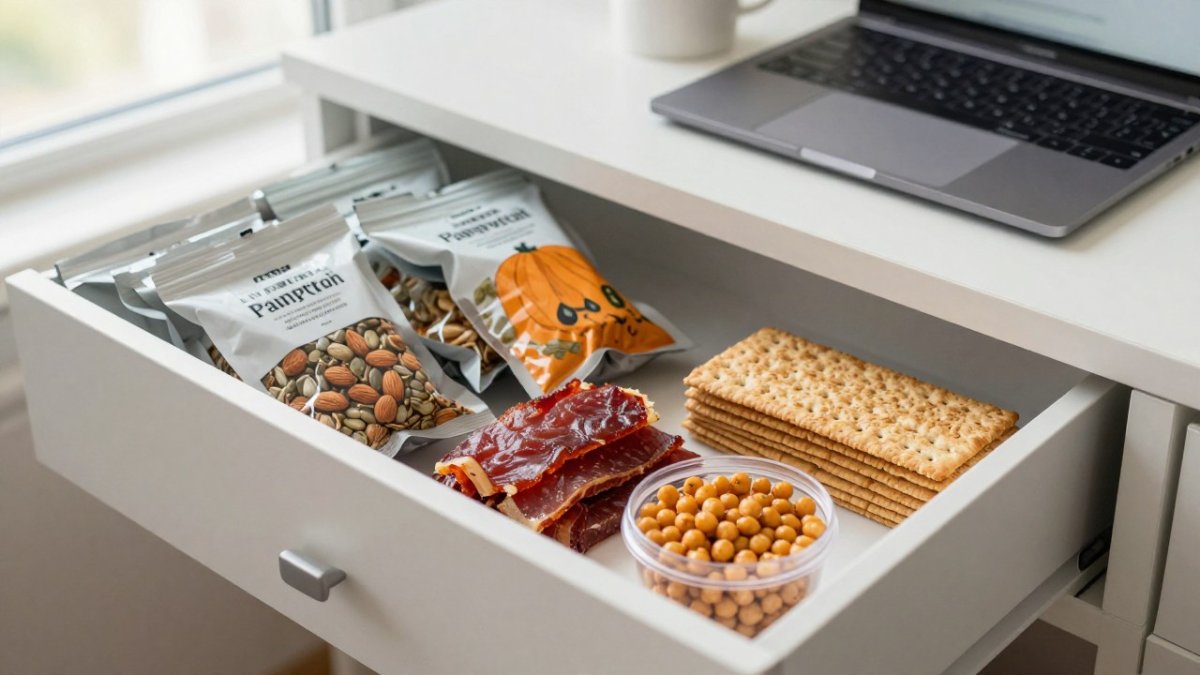
A common mistake is buying family-size bags. Portion them into small containers on Sunday night, or you will finish a week's worth of almonds by Wednesday. Watch out: dried fruit is easy to overeat and often carries added sugar, so read the label and treat it as a topping rather than a standalone snack.
Healthy Snacks for Work No Fridge Required: Nuts, Seeds, and Whole Grains
Healthy snacks for work with no fridge come down to three dependable categories: nuts and seeds, whole grains, and shelf-stable protein. Each brings something different to the formula.
| Snack | Key Nutrients | Best For | Watch Out For |
|---|---|---|---|
| Walnuts | Omega-3 fatty acids, healthy fats | Brain food, satiety | Calorie-dense; portion carefully |
| Pumpkin seeds | Protein, magnesium, fiber | Sustained energy | Buy unsalted where possible |
| Chia seeds | Fiber, omega-3s | Stirred into yogurt or water | Needs liquid to be palatable |
| Roasted chickpeas | Protein, fiber, complex carbs | Crunchy replacement for chips | Check for added oils |
| Whole-grain crackers | Complex carbohydrates, fiber | Pairing with hummus or nut butter | "Multigrain" is not whole grain |
| Dark chocolate | Antioxidants | A small sweet finish | Choose 70% cacao or higher |
Nuts and seeds are the most portable option on this list. A small bag of walnuts or pumpkin seeds travels well, needs no fridge, and pairs with almost anything. Whole-grain crackers work best as a base, not a snack on their own, because they lack protein and fat.
Brain Food for Memory and Concentration: What the Evidence Actually Supports
Brain food for memory and concentration is real, but the claims deserve a clear framework. The honest position is that snacks support focus mainly by preventing the hunger, irritability, and energy dip that wreck concentration, and only secondarily through any direct cognitive effect. Separating those two mechanisms is the difference between a useful snack plan and a marketing pitch.
What the evidence supports. The strongest and most consistent findings concern overall dietary patterns rather than single snacks. Eating patterns rich in vegetables, fruit, nuts, seeds, whole grains, and unsaturated fats, and low in refined carbohydrates and added sugar, are associated with better long-term cognitive health in large observational studies.
What the evidence does not support. No credible research shows that a specific snack produces a measurable boost in focus, memory, or concentration within minutes of eating. Claims that a product is "clinically proven to sharpen focus" usually rest on small studies, surrogate measures, or industry funding, and they rarely survive replication.
The mechanism that actually matters at 3 p.m. The workday focus problem is usually a blood sugar problem. A snack built on refined carbohydrates and added sugar raises blood glucose quickly and drops it again within an hour or two, and the drop is what produces the familiar slump: irritability, hunger, and difficulty concentrating.
A practical way to judge a focus claim. Ask three questions of any snack marketed for brain health: Does the claim describe a short-term cognitive effect or a long-term dietary pattern? Is the evidence from a randomized controlled trial in humans, or from a cell study or an observational association? And does the product's own ingredient list undercut the claim by leading with sugar or refined flour? A snack that passes the ingredient checks in the previous section and fits a balanced formula is a reasonable choice whether or not it carries a brain-health claim.
Where the realistic goal sits. The goal is a steady baseline, not a cognitive upgrade. A planned snack that prevents hunger and the energy dip protects the focus you already have. Anti-inflammatory eating patterns, built around whole foods and unsaturated fats, are the more defensible long-term argument, and they align with the same clean label choices covered above.
Watch out: a product can be genuinely clean label and still make unsupported cognitive claims, so judge the ingredient panel and the evidence separately rather than letting a brain-health badge substitute for either.
Building a Desk-Friendly Snack Plan for Different Workdays
A snack plan should match the shape of your day, not sit on a generic list. Meeting-heavy days need quiet, no-crumb options. Deep-work days need something you can eat one-handed. Travel days need items that survive a bag.
Try this weekly framework:
- Monday, planning day: Greek yogurt with berries and chia seeds, eaten at your desk.
- Tuesday, back-to-back meetings: Walnuts and a few dark chocolate squares, silent and mess-free.
- Wednesday, deep work: Biltong strips with whole-grain crackers for a protein-forward bridge.
- Thursday, travel or offsite: Pumpkin seeds and a nut butter packet, both shelf-stable.
- Friday, lighter day: Apple slices with nut butter, fresh but simple.
For guidance on fitting cured meat into a wider eating pattern, read how to fit biltong into a balanced diet.
Stocking Your Office with Shaka Braai Biltong and Droewors
Stocking an office drawer is easier when the protein option is shelf-stable and preservative-free. Our biltong and droewors are cured meats made without preservatives, which makes them a natural fit for a desk drawer or a shared office pantry.
If shelf life is your concern, our guide on whether preservative-free biltong is shelf stable answers the shipping and pantry questions directly. For offices, order a few varieties so the drawer does not get boring: biltong for slicing, droewors for a grab-and-go stick. When the team is in the office for a longer stretch, a catering spread is the other option worth considering.
The vending machine wins by default when your drawer is empty. Build the habit once, restock on a set day each week, and the 3 p.m. crash stops dictating your afternoon. Shaka Braai brings over 20 years of family-run experience to preservative-free biltong and droewors, all USDA-approved, with online ordering and shipping across the country. Get started with Shaka Braai and keep your desk stocked with protein that actually holds you until dinner.
Frequently Asked Questions
Which portable snacks can you keep at work without refrigeration?
Nuts, seeds, roasted chickpeas, whole-grain crackers, nut butter packets, dried fruit, dark chocolate, and cured meats are commonly kept at room temperature. Check the label for storage instructions and use-by dates, and keep portions in sealed containers so they stay crisp. These clean label snacks fit easily in a desk drawer and give you protein, fiber, and healthy fats without a fridge.
What should you look for on a clean-label snack ingredient list?
Start with a short list of recognizable ingredients: nuts, seeds, fruit, whole grains, or meat with simple seasoning. Watch for added sugar, syrups, artificial colors, and preservatives. Ingredients are typically listed by weight, so anything near the top is present in larger amounts. A clean label snack usually names what it is, not a long list of additives designed to extend shelf life.
How can you choose snacks that help avoid an afternoon energy slump?
Pair protein with fiber and healthy fats rather than reaching for a sugary snack. Combinations like Greek yogurt with berries, an apple with nut butter, or biltong with a handful of walnuts slow digestion and keep blood sugar steadier. Eat a small snack mid-morning or mid-afternoon rather than waiting until you are starving, and keep portions modest so you stay comfortable and focused.
What is a good brain food for memory and concentration?
Walnuts, pumpkin seeds, chia seeds, berries, and fatty fish are often linked to brain health because of omega-3 fatty acids and antioxidants. Whole grains provide complex carbohydrates that fuel steady energy. No single snack guarantees sharper memory, but a consistent pattern of nutrient-dense foods supports workday energy and focus better than sugary or heavily processed options.